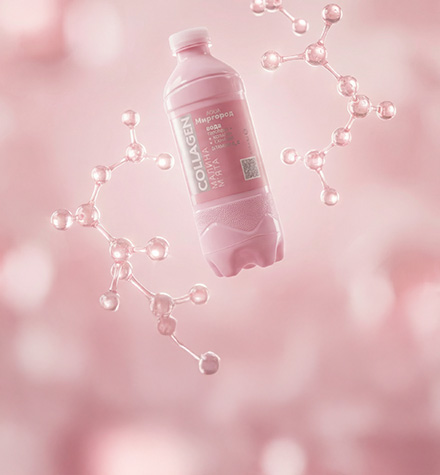


Collagen is a protein structure that shapes our body
Collagen is a structural protein of connective tissue. Its molecule resembles a strong rope twisted in a spiral from three amino acid strands. It is the main component of connective tissue. If there is enough collagen in the body, the skin, blood vessels, cartilage and muscle tissue are elastic. As soon as its amount decreases, the skin can lose elasticity and the body loses mobility. This protein creates a matrix that holds the shape of tissues, ensuring their elasticity and resistance to stress. Up to 30 types of collagen are synthesized in the body. Three of them are most common. The first is responsible for the strength of the skin and bones, the second for the smoothness of cartilage, and the third for the elasticity of blood vessels and soft tissues. Our body produces them on its own, but this ability gradually decreases. Scientists believe that from about the age of 25, collagen synthesis slows down, and this is why age-related changes become noticeable.Where does collagen come from?
Collagen is formed inside our body. It is produced by special connective tissue cells: fibroblasts in the skin, chondroblasts in cartilage, and osteoblasts in bones. They work continuously, building the skeleton of our body. To create new collagen, these cells need building materials - amino acids (primarily proline, glycine, and lysine), as well as "tools" - vitamin C, iron, oxygen, and enzymes that trigger synthesis. This is a complex process. For example, to convert the amino acid proline into a more active form - hydroxyproline, a special enzyme is needed. And this enzyme works only when there are enough of two things: oxygen and bivalent iron. And here there is another important participant - vitamin C. It helps iron to go into the bivalent form that the body can use in this process. If vitamin C is lacking, synthesis continues, but the fibers turn out to be weaker, less elastic. Therefore, collagen in the body is sufficient when the body receives enough nutrients and is not in a state of stress or deficiency. If it is not enough, you can replenish the reserves by eating collagen products. These are ready-made protein fragments that facilitate the body's work.How does collagen work inside the body?
In each type of tissue, collagen plays its role. In the skin, it creates a flexible frame that maintains its shape and prevents sagging. During movement, it works as a shock absorber: it can help joints slide smoothly, reduce friction and maintain an even load on cartilage. In bones, collagen is the main "matrix" on which minerals are deposited. The strength of bone tissue, its ability to withstand shocks and recover depends on the state of this protein. In muscles, it is responsible for elasticity and the quality of recovery after physical activity. Even blood vessels “rely” on it: collagen fibers make their walls elastic, maintain uniform blood flow and protect against excessive fragility. Collagen is invisible, but it builds almost every centimeter of our body. Its action is systemic, slow, but fundamental.Why do we lose collagen?
A decrease in the amount of collagen is not a sudden process, but a slow change that begins at a young age. The body restores it every time after stress, but over the years the rate of synthesis weakens. However, natural decline is only part of the picture. The quality of collagen fibers is influenced by factors that we often underestimate.What to do to prevent the body from losing collagen:
- Ultraviolet destroys the structure of fibers and makes them brittle. Do not stay in the sun unnecessarily and do not neglect sunscreens. Also take vitamin D.
- Excess sugar accelerates glycation processes - reactions that "glue" proteins, depriving them of flexibility. Review your diet and reduce the amount of sugar.
- Chronic stress directs the body's resources to overcome tension, rather than regeneration, and connective tissues suffer first. Therefore, if you cannot avoid stress factors, take phyto-remedies for stress.
- Lack of sleep reduces the level of hormones responsible for recovery, so collagen structures are updated more slowly. You should sleep at least 7-9 hours a day.
- Smoking, including passive smoking, significantly impairs collagen synthesis. Give up bad habits if you don't want to have dry skin and inactive joints at a young age.
- Lack of physical activity impairs blood circulation in the connective tissue, and the amount of collagen decreases. If you want to stay young longer, move more.
Collagen in the diet: natural support and a scientific approach
Nutrition can affect the body's ability to synthesize new collagen. Animal products, fish, egg whites, and bone broths contain the amino acids needed to build protein fibers. However, the human body does not absorb collagen in the form of collagen: it breaks it down into amino acids and peptides, and then synthesizes its own from them. To improve this process, food can be heat-treated to break down collagen into individual chains of amino acids. Then the collagen is transformed into gelatin, which is better absorbed by the body. Progress and scientific research have invented a way to make collagen even more accessible to the body. It is ground in a special way and a number of technically complex manipulations are carried out. The result is the so-called food, or hydrolyzed, collagen. Scientific research pays special attention to hydrolyzed collagen. Thanks to the crushed peptides, it easily passes through the digestive system and is more effectively incorporated into tissues. For this support to work, the body must have enough resources to complete the synthesis, which is why a balanced diet and sufficient hydration play a key role.Collagen Drinks: A Modern Format for Daily Support
As the rhythm of life becomes more and more dynamic, the body needs simple and stable solutions. The format of drinks with added collagen emerged precisely as a response to this need: it combines habitual hydration and support of structural proteins without additional rituals or complex schemes. The drinkable form of collagen is easily integrated into everyday life - it is enough to simply replace part of the usual liquid with a source that does more than just quench thirst. One of such solutions is AQUA Myrgorod COLLAGEN water. However, if you want to find a universal source of collagen, like a "magic pill", we will disappoint you. In the field of health, everything remains traditional. To support your own collagen synthesis, it is enough to take care of your diet, get enough protein and vitamin C, avoid chronic stress and excessive sun exposure. And when the need arises, it is quite appropriate to use collagen in a convenient format.Take care of your youth and beauty every day - your body will thank you much more than you think.